Games Pub

  • Subscribe to our RSS feed.
  • Twitter
  • StumbleUpon
  • Reddit
  • Facebook
  • Digg
Showing posts with label Pushpenny. Show all posts

Sunday, 24 November 2013

A Collection of Shove Ha'pennys

Posted on 02:47 by Unknown
The almost limitless variety to be found in manufactured and home made Shove Ha'penny boards is a dangerous thing for those of us with a penchant for collecting. Putting aside the relatively common and quite similar boards which were manufactured by Jaques, K&C, Wisden's etc. it seems that from my own observations almost every carpenter, cabinet maker, joiner, and sundry other craftsmen would have knocked up a few boards for sale locally. Add to this the literally thousands of handcrafted boards made by locals and hobbyists, and clearly it's not a collection anyone is ever likely to complete.

© John Penny
Of course, when I use the word 'variety' in the context of Shove Ha'penny boards, I'm referring to quite subtle differences in what is essentially the same basic form. To the untrained eye, one wooden Shove Ha'penny might look much the same as another, but it's these subtle differences which make it hard for the enthusiast to resist acquiring yet another piece of highly polished timber or slate whenever one comes up for sale.

The slate shown on the right is from fellow enthusiast, and keen Dorset/Somerset skittler John Penny's collection. I don't know how many boards John has, but I do know that pub games are a passion, and I hope to feature more from his collection in future posts on this blog.

This example was made by Alfred Merewood of 36 Surrey Street, Portsmouth. Cabinet maker? Games Manufacture? I've been unable to find any details of the business online. The slate itself is similar to the more commonly found 'Imp' Shove Ha'penny boards, which were embellished with a cheaper and less attractive plastic end stop than the fine wooden one on this board.

© John Penny
Smooth and durable Slate seems to have been the preferred material for Shove Ha'penny boards in pubs throughout the West Country, with many still in existence in their natural home.

The one shown to the left is located a little further east of this at the White Lion Inn, Wherwell, Hampshire. It's a very serious chunk of slate, not the kind of thing that wants moving around too much but ideal for pub use. It also features five handy recesses in the wooden end stop for the coins.

John has speculated that this may in fact be a Pushpenny given that the recesses are a good fit for old pennies. It's all in the bed depth though, which is hard to gauge from a photo. Perhaps John will have a game the next time he visits.


© John Penny
The detail on the wooden Shove Ha'penny shown above (and below) is a beautifully made, and very neat solution to the safe storage of coins or tokens when not in use. This board was made by John's great uncle, obviously a skilled craftsman, and is certainly pre-war in date.

Of course any half decent collection of Shove Ha'penny boards requires an accompanying collection of Shove Ha'penny Tokens. Here we have examples from the St Georges Series, the Shove Ha'penny Control Association, and assorted plain brass and silvered discs. Judging by the examples shown here, tokens for the game are also an area ripe for the collector.

© John Penny
I think it's true to say that the examples shown above represent the most common materials used for Shove Ha'penny boards, though I've also seen Marble and Granite used on occasion. But every now and then something truly unusual comes to light which makes the point that any hard smooth surface will do for the game, and of course there's really no reason to stick with natural and traditional materials. The board shown below was recently acquired from a snooker club in Cheltenham which was having a clear out. It's very heavy, very smooth indeed, and made from what appears to be some form of man-made resin or laminate such as Paxolin.


It's an unusual board in other ways. It's hard to imagine this would have been 'manufactured', and yet the lines have been precision cut in a way that suggests it was machine tooled rather than cut by hand. The end stop is made from some kind of industrial plastic capping which is effective but quite rudimentary and lacking elegance, and the bracing baton underneath is an off cut, still with vestiges of the paint from its previous life.

The design of the playing surface is unusual too, with a semi-circular 'D' zone, and two inexplicable circles in the end zone. Quite a mystery, and given that I still haven't managed to find out the true purpose of the more common 'D' zone, not one I'm likely to solve to be honest.
Read More
Posted in Pushpenny, Shove Ha'penny | No comments

Monday, 16 September 2013

Pushpenny and a Government Issue Shove Ha'penny!

Posted on 09:22 by Unknown
The Shove Ha'penny Board shown here was a recent inexpensive acquisition from a vintage stall in Gloucestershire. No information on its origin was forthcoming from the dealer, which is a shame but usually the case.

At first glance it appears to be little more than a cheap homemade board, very similar in appearance to another inexpensive board which has already featured on this blog. Both are constructed from three planks of tongue and groove timber, and both have a similar three piece end stop arrangement. In fact the timbers are thinner and longer on this board, and it's probably made from a better quality hardwood, but nevertheless, the design is essentially identical.

The main difference between the two boards, and what makes this one slightly more interesting than most, is only noticeable on closer examination of the edges and underside.


The stamped mark shown above can be found on one edge of the playing surface, and seems to me to represent most of the lettering of London games manufacturer Jaques. As you can see, there is more lettering above this, but it's position on the very edge of the board makes it too indistinct to read. If we assume this is a Jaques board, it suggests that the company would have made a whole range of different models, from their usual top of the range Mahogany and Brass boards, down to this cheaper, more workmanlike version. Interesting? Well maybe not. Jaques have been around for a very long time, so it's hardly surprising they would have made numerous different models for different markets. There may have been another explanation for a cheaper model like this though, which brings me to the other, much clearer mark located on the bracing baton underneath.


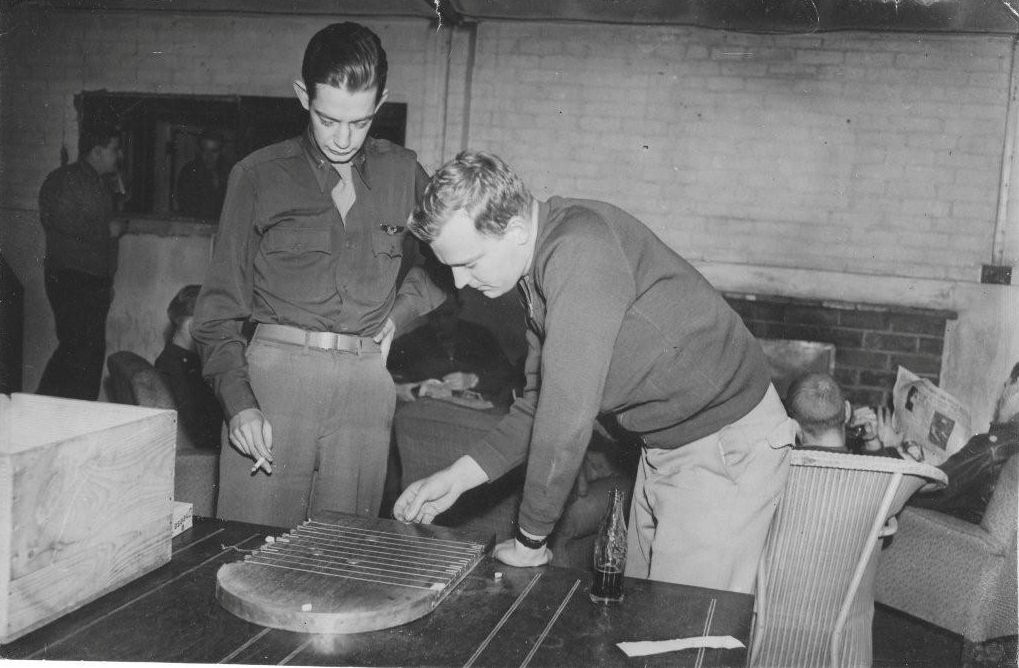
The symbol shown on this image appears to be a Government property stamp with an associated number 56, the purpose of which is not entirely clear but could have been a stores number. Known as a Broad Arrow, this mark was stamped onto all manner of items, military issue equipment and sundries in particular. At first it might seem strange to find a government property mark on a Shove Ha'penny board, but in fact the game seems to have been very popular, and very widely played in the forces at one time. Not only have I seen one or two supposed ex-RAF Shove Ha'penny boards for sale online (for appropriately sky-high prices it must be said), but there are also several photographs from the second world war era showing RAF personnel playing the game as a way to relax between missions (see here and here for example).

Quite whether this board is ex-military issue, or for how long the government would have continued to list Shove Ha'penny boards in its extensive store inventory is hard to say. My best guess is that this board formed part of an order placed by the government to Jaques of London, possibly some time around the second world war. Perhaps this was a special 'war standard' Shove Ha'penny, explaining the cheap and cheerful construction of the board by a company usually noted for the high quality of its numerous games.

Update (23/09/13) - I've now had confirmation from Jaques that this board was indeed a government issue Shove Ha'penny, dating from some time around the second world war. The board will now be joining Jaques own games collection.

Pushpenny

The Pushpennys shown here include a small homemade board (left) which is now part of the fixtures and fittings of The George in Ashley, Northamptonshire. The larger board (right) came in a job lot of junk at an agricultural auction in Melton Mowbray. It was in very poor condition, missing its end-stop, and as can be seen in the image below, had suffered from the attentions of Wood Boring Beetle at some point. I thought it was worth a few quid and set about treating and restoring it to active service. Although similar in most regards to a classic Stamford Pushpenny board, there are a couple of crucial differences likely to preclude this board from serious league play.


The playing surface of a Pushpenny Board is usually made from a tight grained hardwood such as Mahogany, sometimes with a softer wood used for the scoring and end pieces. The board shown here is unusual in that the timber for the playing surface is a fairly smooth softwood (possibly Pitch Pine), with a deep brown, tight grained hardwood used for the scoring strips. A matching piece of hardwood also forms the start of the playing surface. A good deal of work has gone into the construction of this board, including beautifully inlaid hardwood strips to mark each of the nine beds, so it's perhaps surprising that a more suitable wood wasn't chosen in the first place for the playing surface. After some work with fine sandpaper and steel wool, the playing surface has come up to be quite smooth, but I don't think it will ever be as 'fast' as a hardwood board. Maybe it needs a bit more work, or maybe it will get better with a bit of play. It's also worth mentioning that the spacings on this board are a little wider than other Stamford boards I've seen.


Detail of the end stop and side bars on the Pushpenny Board at the George, Ashley.
Read More
Posted in Pushpenny, Shove Ha'penny | No comments

Saturday, 8 June 2013

A Compendium of Pub Games Images - Pt.17

Posted on 01:54 by Unknown

The smiling chap in the Monks Habit on these Playing Cards is a reference to the Benedictine Monks who reputedly discovered Burton-on-Trent's highly regarded Gypsum-rich brewing waters. Marston's Brewery also used the image for their strong Merrie Monk Mild, as well as for a number of pubs including the now closed Merrie Monk in Dunton Basset, a former Leicestershire Table Skittles venue.


A well used brass Put & Take, a game which was very popular with servicemen during the war years, and seemingly purpose made for surreptitious gambling in pubs thereafter. The idea of Put & Take is that a Banker holds the stake, and depending on the fall of the spinner, either pays out or takes money from those playing. Needless to say the odds are always in the bankers favour so this role would be rotated throughout play. Put & Take pieces like this one can still be bought today, though it's hard to say just how much play goes on in the pub or elsewhere, given the relative ease of all manner of gambling pursuits nowadays.


Medals for Dominoes and Northamptonshire Table Skittles. Like most medals, cups, and shields, these are made from base metal these days rather than the Silver or Silver Plate of earlier, more handsome trophies. The skittles medal has quite a nice rendering of the game, the table located in the corner of a bare-boarded bar, as most indeed are. It was originally presented to a gentleman who played the game in pubs throughout Northampton town, for success in either the 'Pepper League' or 'Pepper Cup' competition. The Pepper family have a long association with the game, John Pepper being the last known maker of the traditional Boxwood skittles and cheeses of Northamptonshire Table Skittles.


These 'Darter's Luck' cards were printed for the Darts Club of the Alexandra Arms in Kettering in the 1950's, a pub already featured on this blog for its fine Northamptonshire Skittles Table. These cards were used as fundraisers for the team, passed around the pub, and paying out Four Shillings for a minimum Two Pence stake. The system has proved to be very durable, with almost identical 'Football Cards' still doing the rounds at pub game matches throughout the country. Indeed I was lucky enough to win the modern-day Four Shillings (more like £10) on the Ladies Skittle Team card at the Queen Adelaide, Kingsthorpe last year.


The chances are, if you spend time in a pub which is still frequented by a diverse range of locals, you'll come across a game of Dominoes being played. The game is certainly not as popular as it once was, it's a 'thinking' game of a type which doesn't seem to appeal to younger drinkers, but the game persists nevertheless. The chances are that unless you're in the Bolton area, you're unlikely to see anything other than the common six-spot dominoes in play.

Of course there's no reason why domino sets shouldn't come in other denominations to the standard six, and anything up to twelve spots is known. The higher the number of spots employed, the greater the number of tiles in a set, and in theory the greater the number of players in any one game. In practise though, most leagues in the UK and beyond stick with the tried and trusted six spot option. All except those leagues which operate in the Bolton area, where nine spot Dominoes like those shown above are the norm.

This large Mahogany Pushpenny Board is certainly showing its age. Pitted, scratched, and with a significant crack at the top end of the board. Nevertheless, it plays very well indeed and is a good example of how even with this level of wear, ageing, and even damage, a good quality hardwood Pushpenny or Shove Ha'penny can still be perfectly serviceable.

This board has almost identical spacings to a Stamford Pushpenny board, and the two-piece construction and thick copper stop bar suggests this has been homemade locally from a redundant piece of furniture.
Read More
Posted in Cribbage, Darts, Dominoes, Pushpenny, Put and Take | No comments

Friday, 5 April 2013

A Vintage Pushpenny Board

Posted on 13:32 by Unknown
Pushing Pennies on a Saturday afternoon in the bar of The George, Ashley, Northamptonshire

The game of Pushpenny differs markedly from its more common sidekick Shove Ha'penny in that the boards used for play seem never to have been manufactured. This means that no two Pushpenny Boards will ever be quite the same, in fact they can vary considerably in design and the all important spacings and measurements. The Pushpenny shown here is one of the oldest I've come across, and despite being purchased in Stamford, Lincolnshire, it differs in several respects to the boards currently in use in the local Stamford League.

The most obvious difference is the overall size. This is a large piece of Mahogany even by the standards of the Stamford league where boards are commonly longer than a standard Shove Ha'penny. The run-in is deeper than usual, the playing surface that little bit wider, and perhaps most important of all, the bed depth is significantly shallower than a Stamford board. This all adds up to a particularly difficult board to play, particularly as the surface has been polished to an exceptionally smooth finish, requiring the lightest of touch to avoid overshooting the board.

The original varnish/lacquer which would have originally covered this piece of Mahogany can clearly be seen in this image, and is a good indication that this piece of wood had a very different life before being recycled as a pub game. Only the playing surface and semi-circular end zone has been stripped and polished back to the bare wood. Also of note is the smaller semi-circle above the ninth bed, presumably a scoring option but one which I've yet to find rules for. On this board I've decided to use this additional 'bed', which is quite difficult to score in, as a kind of Joker. Landing a penny in the semi-circle gives the player the opportunity to score once in any bed of their choice.

The three holes shown here are repeated at the other end of the left-hand edge, and may well have been where a pair of hinges were originally located. Perhaps this piece of Mahogany was originally a cupboard door or desk top. Perhaps a cabinet maker may have a better idea. Whether the end piece of wood was contemporary with this is hard to tell. It has been very firmly jointed to the board with tongue-and-groove, and there are useful indentations for pennies and chalk on either side.

The chalk scoring areas are very unusual, being made from strips of inlaid slate screwed onto the surface. This is a feature I've only very rarely seen, and marks this out as being quite a highly crafted board, certainly on a different level to the usual manufactured or home-made pub boards.
Read More
Posted in Pushpenny | No comments

Monday, 4 February 2013

Pushpenny - Two Stamford Boards

Posted on 23:59 by Unknown
The Stamford Pushpenny League pushed off for the 2012/13 season last Autumn. It's good to see that this unique pub league is still being contested in the town, though sadly participation appears to be down to just four pubs and a club now.

Pushpenny boards tend to be jealously guarded when not in league use, if you want to see one in use you'll have to visit one of the participating pubs on a matchday evening. One pub in the town where a good quality board may be available for casual (and careful) play, is the Tobie Norris at the top end of the High Street on St Pauls. The board, which is located in the cosy 'Snug' adjacent to the bar, has a highly polished Mahogany surface, and comes with three smoothed and polished Edwardian pennies, kept safe from harm in an old glasses case. You won't find a better example of a board, and the pub is pretty decent too. It may be a good idea to have a word with the staff before play though.


Stamford Pushpenny Boards are individually hand-crafted and therefore vary slightly from pub to pub. The central playing surface is pretty much standard, with a short run-in, lightly scored lines for the beds, and usually a slight dip at the end of the board to collect over-hit coins. The chalked scoring sections are often separate pieces of wood screwed on to the main body of the board, and there will always be an end stop and a baton of timber attached underneath to brace to board against the table edge. I've puzzled about the depth of the beds, they don't seem to conform to any sensible metric or imperial measure. One possibility which seems to measures up and make some sense, is that the distance is approximately one and a half the diameter of the old pennies used in the game. This gives a wider margin for error in play than in Shove Ha'penny, where the beds are only slightly wider than the coins. The easier scoring in Pushpenny is compensated for by there being only three coins used as opposed to the five played in Shove Ha'penny, also scoring coins are not replayed in Pushpenny to create a 'break'.


I've recently acquired a second Pushpenny board (shown above on the right). This one appears to be made of Teak and follows the standard construction in every way other than having no dip to collect over hit coins at the end of the playing surface. The playing surface on this board was very slow for a Pushpenny, so it's been given a light rub down with wire wool and a good polish up. This has transformed the surface which is now almost as smooth as the Mahogany board I've had for some time. Comparing the two you can see that the length of the playing surface is almost identical, but the width slightly different. One of the main challenges of league play is the slight variations between boards, particularly the 'speed' of the surface which varies widely. The away team are expected to play on the home board(s) giving a clear advantage to the home team.


The coins shown here are Victorian Pennies, entirely smoothed on one side as is the norm for the game of Pushpenny. A set of three like these for use in league play are often smoothed to the point where each coin has a slightly different thickness. Using coins of different 'weight' can help more skilled players when cannoning into a coin already in play. Heavier coins will tend to push up the board, whereas a lighter coin will often bounce back from another weightier penny. The coins shown here are identical in 'weight'.


Read More
Posted in Pushpenny | No comments

Thursday, 19 April 2012

The Hurdler, Stamford

Posted on 11:05 by Unknown
The Hurdler is set a little way out from the town centre of Stamford. A classic community pub, open plan with a central bar, but probably multi-roomed when originally built. It would have been built to serve the needs of the post war housing which surrounds it, and like most pubs which are firmly embedded in their communities, The Hurdler is a games pub through and through. Darts, Crib, and Pool are the principal league games played here, but the pub also has a team in Stamfords unique Pushpenny League.

The league is currently running with just six pubs/clubs, which is a parlous state for any pub game to be in. Let's hope the pubs of Stamford can keep this game going where others have sadly fallen by the wayside.

Two Pushpenny Boards. The nearest is in regular use, made from a single piece of Mahogany, and with a beautifully polished surface. The other board is a little more workmanlike, and is in fact the reverse surface of a Shove Ha'penny Board (see below).

The sloping run-off at the rear of this Pushpenny board can be seen here, and is a feature which is typical of these boards, and yet rarely if ever seen on the more common Shove Ha'penny board.

As far as I can tell, this Shove Ha'penny is a commercial board, of a type which would have been quite common in its time. As shown above, the reverse side has been adapted for Pushpenny, the curved stop bar acting as the brace when used on a table top. How much use the Shove Ha'penny gets at The Hurdler is not clear.

Trophies and the all important fixtures board. This is one of several in the pub, and features the fixture lists for the Crib, and Stamford Pushpenny Leagues.
Read More
Posted in Pushpenny, Shove Ha'penny | No comments

Friday, 13 April 2012

Pushpenny - The Movie

Posted on 01:38 by Unknown


c/o Streak of Genius Films: http://www.streak-of-genius.co.uk/shortfilms.html
Read More
Posted in Pushpenny | No comments

Saturday, 7 April 2012

Pushpenny

Posted on 10:01 by Unknown
Pushpenny is a game similar to Shove Ha'penny, though not nearly as widely played. The object of the game is to propel coins or discs up a highly polished wooden board, landing three in each of nine beds to win. Old Victorian pennies are used in Pushpenny, and the boards are all locally made, and therefore all slightly different. The last remaining centres of Pushpenny play are Stamford in Lincolnshire, and to a lesser extent Hastings in Sussex, though there are surely other boards in regular or occasional use. The Royal Oak near Rugely in Staffordshire is a good example of a pub which proudly boasts a Pushpenny Board.
A Pushpenny Board, probably from the Stamford area originally, but now in my ownership. The playing surface is highly polished Mahogany, with a softer, coarser grained wood used for the scoring areas at the sides. This board has a slightly shallower piece of hardwood screwed to the end of the playing surface to collect over-hit coins, as well as a vertical stop bar. The beds on a Pushpenny Board are designed to accommodate an old Victorian Penny, as opposed to the smaller Half Pennies used in Shove Ha'penny.

My own Pushpenny Board in use on the cider bar at the Leicester CAMRA Beer Festival in 2012

This board is housed at the Jolly Brewer in Stamford. The design is similar to my own, though the slightly shallower run off at the end of the playing surface has been created by planing the wood a little more rather than fixing a separate piece to the main playing board.

This shows the line separating the playing surface from the scoring area,. The attractive worked grooves indicate that these boards are often made by local craftsmen, and with a good measure of skill and pride in the job, not merely as functional pieces of polished wood.
There is a short feature on the Stamford Pushpenny game here: http://www.bestlocalliving.co.uk/2011062310114/Activities-Culture/push-penny.html
Read More
Posted in Pushpenny | No comments
Older Posts Home
Subscribe to: Posts (Atom)

Popular Posts

  • Pub Games at CAMRA Beer Festivals
    The Campaign for Real Ale (CAMRA) have many strings to their campaigning bow, but perhaps the most visible sign of the work the many volunte...
  • The Shove Ha'penny Control Association
    Not much is known about the grandly titled Shove Ha'penny Control Association , which is perhaps surprising given how widespread the gam...
  • Leicester Table Skittles
    The Skittles Table at The Tudor pub in Leicester The Leicester version of Table (or Hood) Skittles is unique and almost entirely local to th...
  • Pattenmakers Arms, Duffield, Derbyshire
    If it wasn't for the fact that so many good pubs have had so much of their character and history 'refurbished' away in recent ye...
  • A Collection of Shove Ha'pennys
    The almost limitless variety to be found in manufactured and home made Shove Ha'penny boards is a dangerous thing for those of us with a...
  • Restoring A Tired Old Shove Ha'penny
    Even though the game of Shove Ha'penny is not nearly as popular as it once was, boards can still be bought new from various sources. At ...
  • The Beacon, Loughborough, Leicestershire
    Perhaps the tidiest purpose built skittle alley I've so far seen is the one located below the Beacon public house in Loughborough. The B...
  • Butcher's Arms, Eldersfield, Gloucestershire
    Variously known as Step Quoits, Table Quoits, Dobbers, and Evesham Quoits (in the Evesham area not surprisingly); this traditional pub game ...
  • Evesham Quoits
    This is my own Evesham Quoits, or Dobbers Board. I'm using the Evesham tag because I know that this board originated from a long-closed ...
  • Four Pub Game Books
    This small two shilling booklet on Inn Games is regarded by Arthur Taylor, author of 'Played in the Pub' ( see below ), as probably...

Categories

  • Aunt Sally
  • Bagatelle
  • Bar Billiards
  • Bedfordshire Skittles
  • Billiards
  • Bowls
  • Cribbage
  • Cribbage Boards
  • Crown & Anchor
  • Daddlums
  • Darts
  • Devil Amongst The Tailors
  • Dominoes
  • Indoor Quoits
  • Leicestershire Table Skittles
  • Long Alley Skittles
  • Nine Men's Morris
  • Norfolk Skittles
  • Northamptonshire Table Skittles
  • Nurdles
  • Pétanque
  • Pitch Penny
  • Poker Dice
  • Pool
  • Pushpenny
  • Put and Take
  • Quoits
  • Ringing the Bull
  • Rings
  • Rugby Table Skittles
  • Scoring Boards
  • Shove Ha'penny
  • Shut The Box
  • Sjoelbak
  • Snooker
  • Table Football
  • Toad in the Hole
  • Twister
  • Western Skittles

Blog Archive

  • ▼  2013 (70)
    • ▼  December (3)
      • Three Crowns, Wymeswold, Leicestershire
      • Leicester Table Skittles
      • Cherry Tree, Catthorpe, Leicestershire
    • ►  November (5)
    • ►  October (5)
    • ►  September (6)
    • ►  August (6)
    • ►  July (6)
    • ►  June (6)
    • ►  May (6)
    • ►  April (7)
    • ►  March (7)
    • ►  February (6)
    • ►  January (7)
  • ►  2012 (102)
    • ►  December (8)
    • ►  November (8)
    • ►  October (9)
    • ►  September (9)
    • ►  August (9)
    • ►  July (10)
    • ►  June (12)
    • ►  May (14)
    • ►  April (23)
Powered by Blogger.

About Me

Unknown
View my complete profile